
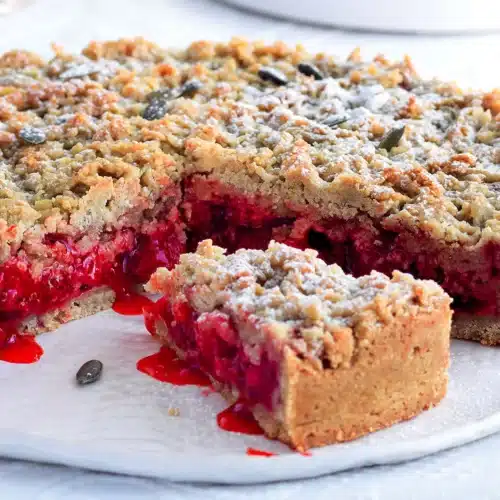
Strawberry Crumble
Ingredients
- 300 g Flour 00
- 100 g Butter
- 400 g Strawberry Jam Noble Roots
- 100 g sugar Semolina
- 1 Egg
- qb Powdered sugar
Instructions
- In a bowl add the flour and granulated sugar and mix them.
- Add butter in cubes and continue kneading
- Add the egg and mix until you get a crumbly mixture.
- Line a 24cm diameter cake tin with a sheet of wet and wrung out baking paper.
- Place a portion of the dough on the bottom of the pan and spread it out without creating breaks.
- Spread the strawberry jam on top and cover it with the rest of the crumb mixture.
- Bake in a hot oven at 180° for 30-35 minutes
- Once ready, let it cool and add icing sugar.
Potrebbero interessarti questi prodotti…
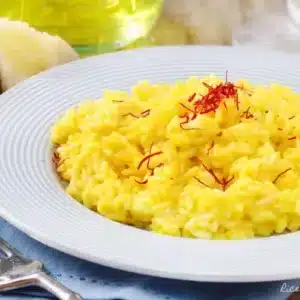
Saffron Risotto
Ingredients
- 2 cups Rice for risottos
- 6 cups Vegetable Broth
- 1 Onion
- 1 Saffron with peacock threads
- 150 g Galbanino Galbans
- qb Pepper
- qb salt
- qb Oil Extra Virgin Olive Oil
Instructions
- The first step is to wash and slice the onion
- Then brown it in a pan over low heat with a drizzle of extra virgin olive oil.
- Once browned, add the rice and toast it until it becomes transparent. At this point, little by little, add the boiling broth
- Salt and Pepper
- Continue adding the broth over low heat and 5 minutes before cooking add the saffron. Then turn off the heat
- At this point, cut the Galbanino into cubes and add it to the mixture and mix.
- Put the lid on and let it rest for 5 minutes. Now the rice is ready to be served.
Potrebbero interessarti questi prodotti…
Cream of fennel, potatoes, leeks and Traditional Balsamic Vinegar
Ingredients
- 4 Fennel medium
- 4 Potatoes average
- 1 Leek
- 1.5 lt Vegetable Broth carrot, celery, onion
- qb salt
- qb Pepper
- qb Balsamic Vinegar of Modena PGI Monari Federzoni
Instructions
- Prepare the vegetable broth and at the same time clean the fennel and cut it into thin slices
- Remove the base of the leek and the green part and then cut it into slices.
- Peel the potatoes and cut them into cubes
- Pour the chopped vegetables into the vegetable stock and cook for 20 minutes with the lid ajar.
- At this point, use an immersion blender to create a smooth cream and cook for another 10 minutes on low heat.
- Finally plate and serve enriching the cream with drops of Balsamic Vinegar
Potrebbero interessarti questi prodotti…
The Yellow Campano Tomato it is grown mainly in the province of Naples and in the surrounding provinces. The main recognized varieties of the place are the Piennolo yellow tomato from Vesuvius and the Yellow Datterino.
Piennolo Yellow Tomato
The Piennolo Yellow Tomato it comes from the Vesuvius area, it is cultivated by hand and harvested between April and September.
Characterized by an oval and elongated shape, the yellow Piennolo tomato can be found hanging in clusters (like a pendulum, hence the name "piennolo”), Has a golden yellow color, a rather thick skin and a very sweet taste.
Yellow Datterino
The Yellow Datterino comes in regular clusters (from 14 to 16 fruits each) it is a very vigorous plant with indeterminate development, tolerant to the main tomato diseases, the berry is rounded and slightly flattened at the poles, the color is orange yellow and the pulp has a color salmon pink.
Unlike the classic tomato, it has no acidity. In fact, the yellow datterino it is undoubtedly an excellent tomato to combine with dishes based on fish or seafood.
Potrebbero interessarti questi prodotti…
In this article you will find out how to measure flour without a scale, are you at a friend's house who does not have a scale or simply yours is broken? Read on and we'll show you how simple it is to weigh flour without a scale.
Weigh flour with a spoon
Yes, it is possible to measure the flour with a simple spoon, just keep in mind that a heaped spoonful of flour corresponds to approximately 20 grams of flour, so 100 grams will correspond to 5 tablespoons.
Weigh flour with a teaspoon
If necessary, you can weigh the flour with a teaspoon, one teaspoon corresponds to approx 10 grams of flour.
Weigh flour with a plastic cup
For extreme evils, extreme remedies, if you do not have a scale to weigh the flour, you can also use a simple plastic cup. A plastic cup of the white ones, in fact, corresponds to approx 130 grams of flour.
Did you know that the history of flour has distant origins? Flour was born thousands of years and is almost indispensable for everyday preparations, also take a look at our article on History of flour "
Potrebbero interessarti questi prodotti…
The word Flour comes from the Latin Flour, in turn derived from far, or the Emmer; in fact, this word comes from the ancients Romans, which originally made use of this cereal to obtain this nourishing powder, which they used for all their preparations.
La più utilizzata oggi, è sicuramente la farina di grano tenero, adatta ad ogni preparazione, dal pane alle focacce alla pizza. Ma ancora oggi, se volete potete sperimentare e provare un’ottima focaccia di farro. Le varianti sono molte, ma ogni macinazione nasce dal grano, esso appartenente alla famiglia delle Graminacee, riconoscibili genericamente per la particolare forma a spiga, il grano è una delle specie vegetali più coltivate al mondo.
The Origins of Flour: Who Invented Flour?
Flour is thought to have been invented by the peoples of Asia Minor, in the famous Fertile Crescent, located between the Tigris and Euphrates rivers. The cultivation of wheat, and grasses in general, has spread over time throughout Europe, and is today one of the basic foods of good nutrition for many populations all over the world.
With the discovery of America, corn flour also arrived on the tables of Europeans, from which the polenta we know today is born, originally prepared by the Romans with millet or spelled flour.
Oggi esistono molte tipologie di farine adatte a preparazioni di ogni tipo, il termine farina, infatti, non indica più solo i prodotti delle graminacee, ma viene usato anche per molti altri prodotti ottenuti dalla macinazione, tra cui, cereali, frutta secca (mandorle o nocciole), legumi, o semi di varie piante; dalla farina di mais, a quella di avena, nocciole o grano saraceno.
Potrebbero interessarti questi prodotti…
L'extra virgin olive oil Terre Aurunche PDO, according to the production disciplinary, requires the use of olives coming for at least 70% from the cultivar "Sessana". La Sessana originates from the production area from which its name derives, the town of Sessa Aurunca, comune più esteso della zona di produzione, mentre le cultivar minori previste (Itrana, Corniola e Tonacella) sono originarie dei territori confinanti e rappresentano un altrettanto importante patrimonio della biodiversità locale.
L'Terre Aurunche extra virgin olive oil it has excellent physical, chemical and organoleptic characteristics, with an acidity lower than 0.60 and a good content in polyphenols; taste with good bitter and spicy tones, a color ranging from straw yellow to more or less intense green. These characteristics, in addition to the particular varietal composition of the cultivar Sessana, are also due to the simultaneous presence of a mild climate and a volcanic soil, rich in macroelements and microelements essential to the production of olives and quality oil.
The production area is located in the northern part of the province of Caserta, in the area around extinct volcano of Roccamonfina, in the olive groves of the municipalities of Caianello, Carinola, Cellole, Conca della Campania, Falciano del Massico, Francolise, Galluccio, Marzano Appio, Mignano Monte Lungo, Mondragone, Rocca D'Evandro, Roccamonfina, San Pietro, Sessa Aurunca, Sparanise, Teano and Tora and Piccilli.
The surface of the olive groves involved in the production of thisextra virgin olive oil DOP it is estimated at around 6,000 hectares, for an average annual oil production of around 18,000 quintals per year.
From the producer to the table
II Porto di Mola oil mill rises on the slopes of the volcano off of Roccamonfina, with his gaze turned towards the Appian Way. A small corner of paradise which, thanks to the peculiar characteristics of the soil, is able to give its products a unique and peculiar flavor, which contains all the scents of the historic "Land of Work".
The Frantoio is located near a ancient Roman trading port, found in an archaeological excavation in 1992, which inspired the name of the company. In this territory theOlive oil it was already transported in ancient times, acting as a hub between the traders and producers of the area, who started a tradition that is still alive in the modern Frantoio.
Thanks to its geographical position, in the center of a basin rich in olive groves in the Roccamonfina Regional Park - Foce Garigliano, the Frantoio welcomes olives from all the neighboring municipalities: Galluccio, Conca della Campania, Mignano Monte Lungo, Sessa Aurunca, Teano, Suio, Rocca d'Evandro, San Vittore Del Lazio and many others in the vicinity.
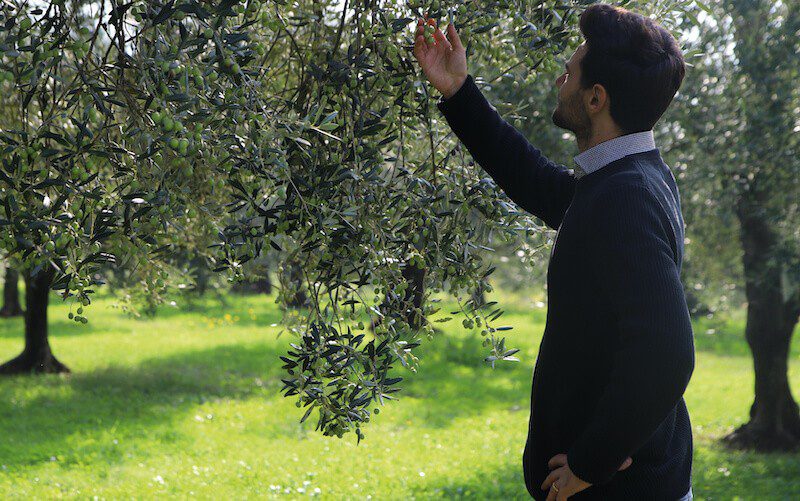
Scopri i prodotti Porto di Mola »
Potrebbero interessarti questi prodotti…
Papaccelle, also called "paprecchie" or "pupaccelle" are small, globular peppers grown throughout Campania. round, of an intense red or green color, flattened at the poles and extremely ribbed, with a pulp with a full and crunchy consistency and a very aromatic and characteristic flavor. Some ecotypes are more or less spicy, and are mostly used to be preserved in vinegar. In each area, however, there are culinary variations for the preparation of papaccelle: seasoned with tomato sauce or stuffed and served as a side dish, used fresh or preserved, they are, in short, a very characteristic ingredient of many typical recipes.
Potrebbero interessarti questi prodotti…

Homemade Bretzel recipe
Ingredients
- 500 g Flour "0"
- 250 ml water Lukewarm
- 30 g Butter at room temperature
- 2 teaspoons salt
- 1 teaspoon sugar
- 25 g Brewer's yeast or 1/3 of Dry Yeast
Solution for wetting the pretzels
- 3 spoons Bicarbonate in 1 liter of water
or
- 30 g NaOH tablets in 1 liter of water
Instructions
Preparation NaOH solution
- Pour COLD water into a steel or glass bowl (Absolutely not plastic) and add the NaOH tablets that you will have to try to dissolve by stirring slowly to avoid dispersion, with a steel spoon. The solution of water and sodium hydroxide is very dangerous, so if you are not sure what you are doing we recommend using the bicarbonate as an alternative.
- If, at the end of the whole procedure, there is some solution left over, it can be kept in a glass jar. For safety reasons it is essential to keep it away from food or foods and apply a & #39; label specifying that it is a burning substance.
Dough preparation
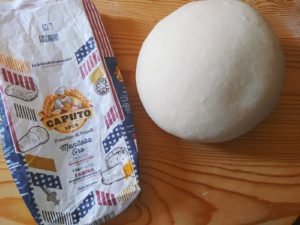
- Place the flour in a fountain, in the center dissolve the yeast with warm water and a teaspoon of sugar.
- Mix incorporating a little flour and let it rest for about 15 minutes. Then add the salt and soft butter.
- Knead for a long time until the dough is smooth and well strung.

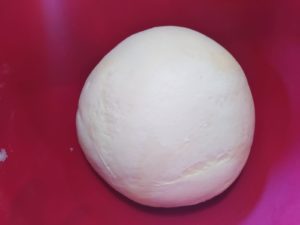
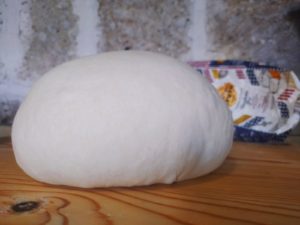
- Leave to rise for about 40 minutes in a bowl lined with cling film and placed in a warm place.
- The dough must be compact enough to be worked without sticking to the hands.
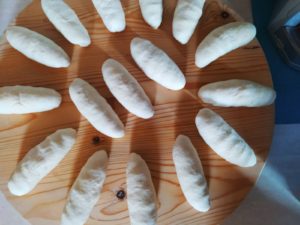
- From the dough, form 16 elongated balls of about 50 g.
- Form the Bretzel by obtaining strands about 50 cm long, thicker in the center and thinned at the ends and give them the classic shape.
- Put them on a greased plate or with parchment paper and let them rest for about 20 minutes at room temperature so that they swell slightly, then place them in the refrigerator for about an hour. This will form a thicker crust which will ensure the baked Bretzel has a more glossy appearance.
- The hardest part: prepare the solution as described above and, being very careful not to come into contact with your hands and eyes, dip the bretzels in, one at a time and leave them immersed for about 10 seconds (if they are well risen they will float), recover them finally with a perforated steel pallet. We remind you that as an alternative to the NaOH solution you can use bicarbonate which is completely harmless and without dangers.
- Let them drain very well, placing the perforated spatula, with the pretzel on top, on a cloth that is able to absorb the excess liquid and then place them gradually on a baking sheet lined with parchment paper.
- Score the surface by making a cut in the thickest part lengthwise and sprinkle with coarse salt.
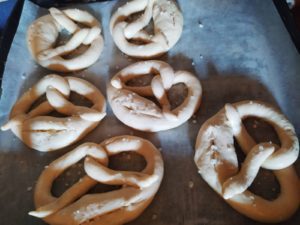
Cooking
- Bake at 200 ° until the pretzels become golden of the classic dark brown color, they usually take about 20/25 minutes for cooking.

Notes
Potrebbero interessarti questi prodotti…
Wine Ciambelline Recipe
Ingredients
- 500 g Flour "00"
- 150 ml White wine
- 100 ml Oil of sunflower seeds
- 150 g sugar + extra for coverage
- 1 Spoon Aniseed
- 8 g Yeast for sweets
Instructions
Preparation
- In a bowl, sift the flour and yeast and put all the other ingredients in the center.
- Start kneading until you get a smooth dough.
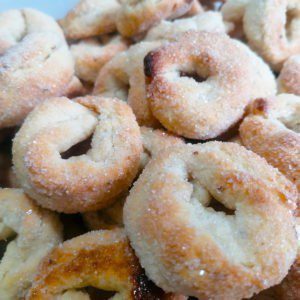
- Form some cords of dough about 15 cm long and about 1 cm thick and close into a ring.
- Pass only one side in the sugar and place the donuts on a baking sheet lined with parchment paper.
Cooking
- Bake in a preheated oven at 180 ° for about 20 minutes, as always, the cooking times may vary depending on the type of oven and the size we have given to the donuts.
- Allow to cool before serving your donuts.